





 Post by
If your business serves customers in the UAE, the UK and the USA, search engines need clear signals about which page belongs to which audience. This hreflang implementation guide walks you through the process step by step, from choosing the right codes to testing the final setup. It is written for marketers, developers and business owners running multi-regional websites.
What Hreflang Does and Why It Matters
Hreflang is an annotation that tells search engines which language and regional version of a page to show a particular user. When you publish similar English content for several markets, hreflang tags help Google serve the UK page to UK searchers, the US page to American searchers and the UAE page to users in the Emirates.
Without these signals, search engines may treat near-identical pages as duplicates or show the wrong version in results. That leads to confusing prices, wrong currencies, mismatched spelling and lost conversions. It is a core part of SEO in digital marketing for any brand that sells across borders.
Keep in mind that hreflang is a hint, not a directive. It helps search engines choose between your own pages. It does not boost rankings by itself, and it does not replace good content, local relevance and solid technical foundations.
Choosing Language and Region Codes
Each hreflang value combines a language code (ISO 639-1) with an optional region code (ISO 3166-1 Alpha 2). For a three-market English setup, the common values are:
- en-ae for English content aimed at the United Arab Emirates
- en-gb for the United Kingdom
- en-us for the United States
en-gb vs en-us hreflang
The difference between en-gb and en-us is not only spelling. It also covers currency, units, date formats, delivery details, legal wording and product naming. Use separate URLs only when the content genuinely differs. If the pages are truly identical, a single English page may be simpler and avoids wasted crawl effort.
Note that the code is “gb” and not “uk”. Using en-uk is one of the most frequent errors, and it will be ignored.
Using hreflang x-default
The hreflang x-default value marks the fallback page for users who do not match any listed language or region. This is often a global English page or a language selector. For a UAE, UK and US setup, many businesses point x-default to the version that best serves international visitors.
Implementing Hreflang in HTML, Headers, and Sitemaps
There are three valid methods. Choose one and apply it consistently rather than mixing them without reason.
Method 1: HTML link elements
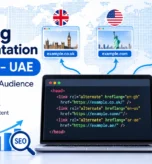
Add link elements inside the head of every page version. Each page must list all alternates, including itself:
- rel=”alternate” hreflang=”en-ae” href=”your UAE URL”
- rel=”alternate” hreflang=”en-gb” href=”your UK URL”
- rel=”alternate” hreflang=”en-us” href=”your US URL”
- rel=”alternate” hreflang=”x-default” href=”your fallback URL”
This works well for smaller sites with a manageable number of pages.
Method 2: HTTP headers
For non-HTML files such as PDFs, you can send hreflang information through the HTTP Link header. This is configured at server level and suits downloadable resources.
Method 3: XML sitemaps
For larger sites, listing alternates in the XML sitemap keeps templates clean and is easier to maintain at scale. Each URL entry includes xhtml:link elements for every language and region version, including itself.
Whichever method you use, always use absolute, fully qualified URLs and make sure each URL returns a 200 status code.
Hreflang on WordPress Sites
Hreflang for WordPress sites is usually handled through a multilingual or SEO plugin, or through custom code in the theme. The right option depends on your structure:
- Multisite or subdirectories such as /ae/, /uk/ and /us/ are easy to manage and consolidate domain authority.
- Country-code domains give strong geographic signals but need more investment per site.
- Subdomains sit in between, though they are often treated as separate sites.
Whatever you choose, confirm that the plugin outputs reciprocal tags and uses canonical URLs correctly. Custom builds often need developer input, and our web development team regularly configures this for multi-regional projects. Also review your search engine optimization resources for related technical checks.
Common Mistakes and How to Fix Them
Most common hreflang errors come from a small set of causes. Here is what to look for:
- Missing return tags. If page A points to page B, page B must point back to page A. Add reciprocal annotations on every version.
- Wrong codes. Use en-gb, not en-uk, and make sure the language code comes first.
- Missing self-reference. Each page should include a tag pointing to itself.
- Conflicting canonicals. A page that canonicalises to a different regional URL cancels its own hreflang. Each version should canonicalise to itself.
- Pointing to redirected or blocked URLs. Alternates must be indexable and return a 200 status.
- Mixing methods inconsistently. Conflicting signals from HTML and sitemaps cause confusion.
- Targeting a region without content differences. Thin duplicates add maintenance with little benefit.
Fixing these multi-country website SEO issues is usually a matter of cleaning up templates and re-crawling the site.
Testing and Monitoring Your Setup
After implementation, verify your work rather than assuming it is correct.
- Crawl the site with a technical SEO crawler that reports hreflang issues such as missing return links and invalid codes.
- Check Google Search Console for indexing and coverage problems on each regional version.
- Search from each target market, or use location-aware tools, to confirm the right page appears.
- Re-audit after site migrations, redesigns or plugin updates, since these often break annotations.
Monitoring matters because hreflang is easy to break when new pages are added without being mapped to their regional equivalents.
Next Step for Your International SEO
A clean hreflang setup is one part of a wider international SEO strategy that also covers localised content, structured site architecture and regional link building. If you want help auditing or implementing multi-regional SEO for your UAE, UK or US audiences, Neoline Logic combines SEO and development expertise to get it right the first time. Get in touch for a technical review of your current setup.