





 Post by
If your online store sells to American customers, ecommerce SEO USA is about far more than adding keywords to product titles. It means matching how US shoppers search, structuring your catalog so search engines can crawl it, and sending clear signals about pricing, shipping and trust. Many UAE-based brands and agencies now serve the US market, and this guide covers the tactics that matter most for online stores.
At Neoline Logic, we build and optimize online stores for businesses in the UAE and abroad, including the USA. Below is a practical ecommerce SEO strategy you can apply whether you run Shopify, WooCommerce or a custom platform.
How US Shoppers Search for Products
US buyers often move between informational, comparison and purchase searches before they buy. A shopper might start with “best running shoes for flat feet,” narrow to a category such as “stability running shoes,” and finally search for a specific model. Your store needs a page for each stage.
- Informational queries: guides and how-to articles that earn early trust.
- Commercial queries: category pages and comparison content.
- Transactional queries: product pages with price, availability and delivery details.
Use American English spelling and terms (for example, “sneakers,” “apparel,” “cell phone case”) because wording differs from UK and UAE usage and affects which searches you match.
Keyword Research for Product and Category Pages
Good online store SEO starts by assigning one primary keyword to each page. Category pages usually target broader, higher-volume terms, while product pages target specific model, size or feature searches.
- List your categories and map a main keyword to each.
- Gather long-tail variations from search suggestions, competitor-agnostic tools and your own site search data.
- Check the results page for the US to see whether Google favors category pages, product pages or editorial content.
- Avoid assigning the same keyword to two pages, which causes cannibalization.
Category page SEO deserves special attention. Add a short, useful intro, clear subcategory links and filters that do not create thousands of thin URLs.
Optimizing Product Pages and Schema
Product page SEO combines content quality with structured data. Each page should have a unique title tag, a descriptive H1, original product descriptions and high-quality images with descriptive alt text. Avoid copying manufacturer descriptions across many stores.
On-page essentials
- Title tag with the product name and a key attribute.
- Unique description covering materials, sizing, use cases and specifications.
- Customer reviews displayed on the page.
- A short FAQ answering common pre-purchase questions.
Product schema markup for ecommerce
Product schema (JSON-LD) helps search engines understand price, availability, brand and ratings, and can make you eligible for rich results. Include name, image, description, SKU, brand, offers (price, currency, availability) and review data where genuine. Keep schema consistent with what is visible on the page, and test it with Google’s Rich Results Test.
Site Architecture and Technical SEO
A clean structure helps crawlers and shoppers. Aim for important products to be reachable within three clicks of the homepage, with logical breadcrumbs and descriptive URLs.
- Speed and Core Web Vitals: compress images, limit heavy apps and use caching and a CDN. US shoppers are often on mobile, so test on mobile first.
- Faceted navigation: use canonical tags or noindex rules so filter combinations do not flood the index.
- Duplicate content: canonicalize product variants and handle out-of-stock items carefully, keeping pages live when products will return.
- XML sitemaps: separate products, categories and content, and keep them updated.
- Hosting location: choose hosting or a CDN with strong performance for US visitors.
Technical foundations depend on how your store is built. Our guide to ecommerce development explains how platform and architecture choices affect long-term SEO, and our web development resources cover performance and mobile best practices.
SEO for a Shopify store in the USA
Shopify handles many basics, but you should still edit collection descriptions, clean up auto-generated duplicate URLs, add schema through your theme or a trusted app, and control app bloat that slows pages. Customize title tags and meta descriptions rather than relying on defaults.
Currency, Shipping, and Trust Signals
For American shoppers, display prices in USD and be clear about the total cost. If you ship from the UAE or elsewhere, say so honestly and show realistic delivery times, duties and return policies.
- Show USD pricing, and use the correct currency in your Product schema.
- Publish a clear shipping page covering costs, timeframes and regions.
- Explain returns and refunds in plain language.
- Use US-friendly payment options and secure checkout (HTTPS).
- Display contact details, an About page and real customer reviews.
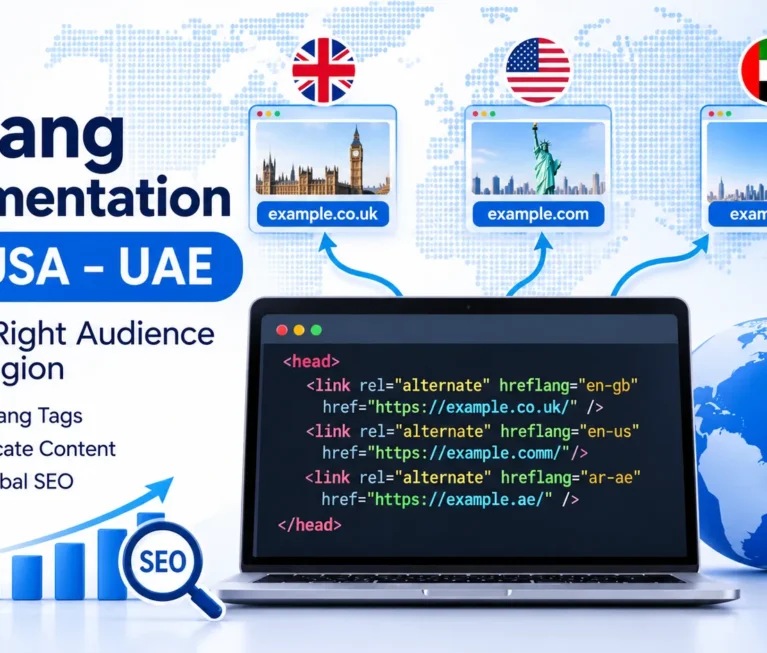
- Use hreflang with en-us if you run separate versions for different countries, so Google serves the right store to the right audience.
These signals support conversions and also reinforce relevance for US searches. Ecommerce SEO checklist items like these are often overlooked by international sellers.
Content and Link Building for Online Stores
Content supports your product and category pages. Buying guides, size charts, comparison pages and care instructions capture shoppers earlier in their journey and link internally to products.
- Build guides around questions customers actually ask support.
- Link from articles to relevant categories with descriptive anchor text.
- Earn links through original data, useful tools, partnerships and PR relevant to your niche.
- Avoid low-quality link schemes, which can harm rankings.
If you are new to the discipline, start with our explainer on what SEO is in digital marketing. For more articles on visibility, browse our Search Engine Optimization category.
When to Hire an Ecommerce SEO Agency
Consider outside help if your catalog has thousands of SKUs, your traffic has plateaued, you are migrating platforms, or you lack in-house technical skills. A good partner should audit your store, explain priorities, and report on revenue and not only rankings.
When evaluating an agency, ask about experience with product schema, faceted navigation, international targeting and how they measure results. Be cautious of guaranteed rankings, which no one can honestly promise.
Neoline Logic combines SEO services with ecommerce development, so technical fixes and content improvements happen in one workflow. Contact our team for an audit of your online store and a roadmap to rank in the US market.