




 Post by
Arabic SEO UAE is the practice of optimising your website so it appears when people in the Emirates search in Arabic. The UAE is a multilingual market where English dominates business, yet a large share of residents and visitors still search, read and buy in Arabic. If your site only targets English queries, you are leaving a real audience to competitors who speak their language.
This guide covers Arabic keyword research, technical SEO for right-to-left (RTL) sites, bilingual site structure, content localisation and how to measure results. If you are new to the fundamentals, start with our explainer on what SEO is in digital marketing.
Why Arabic SEO Matters in the UAE
The UAE population is highly diverse, but Arabic is the official language and is used daily across government, retail, real estate-adjacent searches, services and media. Many users switch between Arabic and English depending on the device, the topic and the situation. Some search in Arabic for local services and in English for technical products.
Arabic search results are also often less crowded than English ones. That means a well-built Arabic page can earn visibility faster than the same effort would in English. Arabic content also signals trust: businesses that speak a customer’s language feel more credible, which supports conversion as well as traffic.
Arabic Keyword Research
Arabic keyword research is not a translation exercise. Direct translations of English keywords often miss how people actually search. Follow this process instead:
- Start with native intent. Ask Arabic-speaking customers and your sales team which words they use for your services.
- Check dialect and spelling variants. Gulf Arabic, Modern Standard Arabic and Arabizi (Arabic written in Latin letters) can all appear in queries. Hamza forms, the letter alef and the ta marbuta are often typed inconsistently.
- Use search suggestions. Google autocomplete, related searches and People Also Ask in Arabic reveal real phrasing.
- Use keyword tools that support Arabic. Google Search Console, Google Keyword Planner and major SEO suites let you set Arabic as the language and the UAE as the location. Treat volume figures as estimates, since Arabic data can be thinner.
- Map each keyword to one page. Avoid two pages competing for the same Arabic query.
Group keywords by intent: informational (how-to questions), commercial (comparisons, best-of) and transactional (service pages with a clear enquiry action).
Technical SEO for RTL Sites

An RTL website needs more than flipped text. Search engines and users both notice layout problems.
Set direction and language correctly
Use the dir attribute set to rtl and a proper language attribute such as ar on Arabic pages. Mirror layouts so navigation, icons, arrows, sliders and breadcrumbs follow right-to-left reading order.
Use Unicode and Arabic-friendly fonts
Use UTF-8 encoding throughout. Choose fonts designed for Arabic script with clear letterforms at small sizes, and test line height, since Arabic characters need more vertical space. Our team covers this in more detail in our guide to UI UX design in the UAE.
Keep URLs and metadata clean
Arabic URLs can work, but they become long percent-encoded strings when shared. Many sites prefer short transliterated or English slugs for Arabic pages. Whichever you choose, stay consistent. Write unique Arabic title tags and meta descriptions, and keep them readable within normal display lengths.
Speed and mobile
Most UAE searches happen on mobile. Compress images, limit font files and test Core Web Vitals on the Arabic version separately, because extra fonts and scripts can slow it down.
Bilingual Site Structure and Hreflang
Bilingual SEO depends on a clear structure that tells Google which version to show to whom. Common options include:
- Subdirectories such as /ar/ for Arabic. This is usually the simplest to manage and keeps authority on one domain.
- Subdomains such as ar.example.com. These are workable but treated more separately.
- Separate domains for each language. These need the most effort and are rarely necessary.
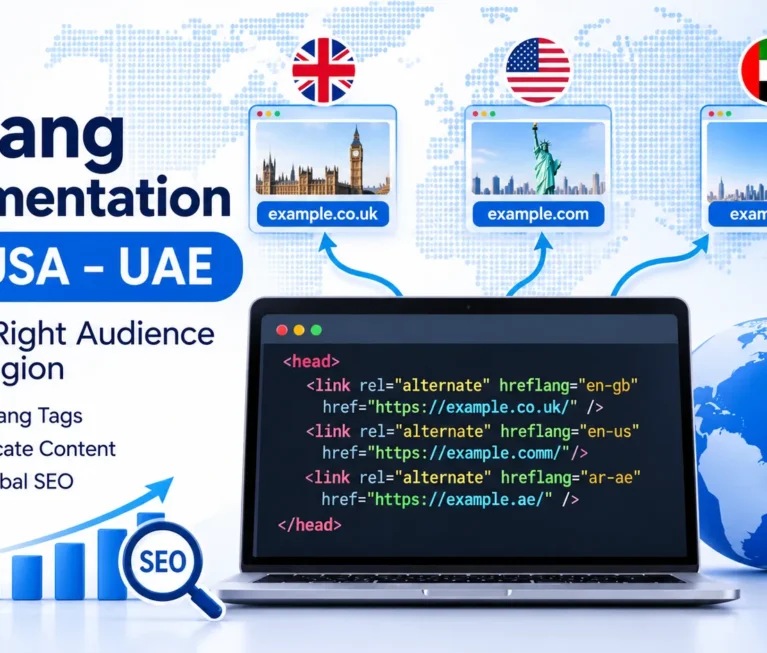
Add hreflang annotations so each page points to its language alternative, including a self-reference. Use ar-AE for Arabic in the UAE and en-AE for English, plus an x-default where appropriate. Hreflang links must be reciprocal: if the English page points to the Arabic one, the Arabic page must point back. Also use self-referencing canonical tags rather than pointing the Arabic page’s canonical to English.
Add a visible language switcher that links to the equivalent page, not just the homepage. Avoid automatic redirects based on browser language, since they can block crawlers and frustrate users.
Content Localisation Tips
Arabic content marketing works best when it is written for Arabic readers, not translated word for word.
- Use native writers or editors. Machine translation alone often produces stiff phrasing that hurts readability and trust.
- Localise examples. Reference UAE cities, local business practices, the dirham and regional events such as Ramadan or national occasions where relevant.
- Match tone. Arabic business writing can be more formal than English. Choose a register that suits your audience.
- Keep headings descriptive. Put the main Arabic keyword in the H1, in at least one H2 and early in the introduction.
- Localise images and design. Avoid images with embedded English text and use alt text written in Arabic.
- Add structured data. Organization, LocalBusiness and FAQ markup should be in Arabic on Arabic pages.
Plan Arabic content around the same themes as your English strategy, then add topics unique to Arabic searchers. For broader planning ideas, see our Marketing articles.
Measuring Results
Track Arabic performance separately so it does not get lost in blended data.
- Google Search Console: filter by country (UAE) and by page path or query language to see impressions, clicks and average position for Arabic pages.
- Analytics: segment by language and landing page to compare engagement, enquiries and conversions.
- Rank tracking: monitor your priority Arabic keywords on mobile and desktop.
- Index coverage: confirm Arabic pages are indexed and that hreflang has no errors.
- Business outcomes: measure calls, form submissions and sales from Arabic visitors, not only traffic.
Review results monthly and expect gradual gains. Update pages whose rankings stall by improving depth, internal links and clarity.
Common Mistakes to Avoid
- Publishing machine-translated pages with no editing.
- Leaving Arabic pages in an English layout that is not mirrored.
- Missing or one-way hreflang tags.
- Duplicating English meta titles on Arabic pages.
- Ignoring Arabic keyword variants and dialect.
Next Step
Arabic SEO rewards businesses that treat language as a strategy, not a plugin. If you want a bilingual site that ranks in both Arabic and English, Neoline Logic can help with keyword research, RTL development and ongoing optimisation. Explore more guidance in our Search Engine Optimization section, then get in touch to plan your Arabic search strategy for the UAE.